

Tim Barnes: Wurlitzer record jukebox King, 1950/60’s Rock and Roll aficionado, American vintage classic car collector, aircraft mechanic and the man who introduced us to the Lasham Gliding Club.
We have occasionally visited Lasham Gliding Society over the past 40 years. Open to the public as well as Gliding Club members, we recently spent a glorious Sunday Lunchtime watching an endless stream of gliders launching into the sky above the Hampshire countryside to silently drift across the miles of verdant landscape at the whims of the breezes and catching thermals to rise high above the farms and villages.
Today we arrived in time to have lunch in the newly refurbished Flight Deck restaurant before signing up for the once a week Sunday tour of the Lasham Gliding Heritage Centre at 2.00 p.m.
We were met by our guides and taken to the Heritage Centre transport vehicles to be driven across the air field to the three Hangers on the south side. The airfield is an active runway and the public are not permitted to walk or drive on the airfield for their safety and for the safety of the towing planes and gliders.
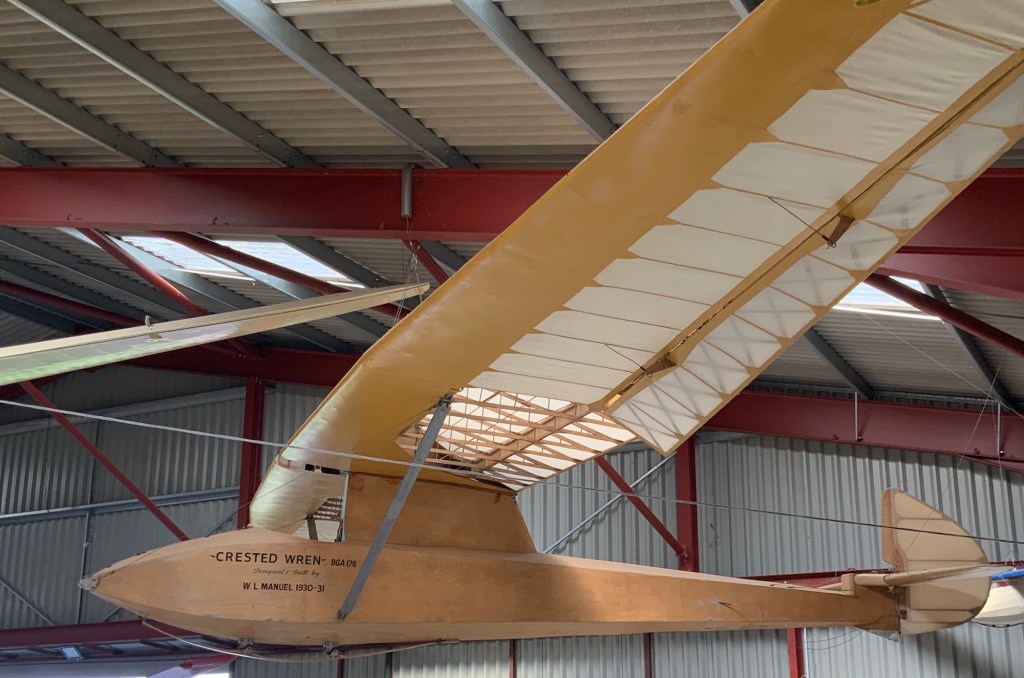
A replica Crested Wren by WL Manual 1930 – 31. Referred to as a “replica” it’s inaccurate to call it that as it was in fact built by Bill Manuel, who built the original back in 1930/31. This Crested Wren was completed by him in 1986 shortly before his death in 1987. Bill Manual started building gliders in the late 1920s at RAF Hawkinge.
The older Gliders in this collection are made from wood. You can see the wooden struts in the wings above. A fabric then covers the ‘skeleton’ of the glider. This is called the skin. It can be thin sheets of wood or fabric or in modern gliders metal or plastic. The skin aids air flow.
Ordinarily when writing blog posts on subjects I know nothing about I would research the gliders and provide a skimmed précis about the subject. However, the volunteers at the Gliding Heritage Centre are very passionate about their collection and extremely knowledgeable. If you possess a hint of contemplation to visit the Lasham Gliding Heritage Centre and their collection of 50 vintage gliders, I believe you need to hear the history of each glider from an expert. Our guide today was the son of two Polish glider pilots. He too is a qualified glider pilot and one could sense the pulse of passion as he described in detail the fascinating stories about each of these hand made aircraft.
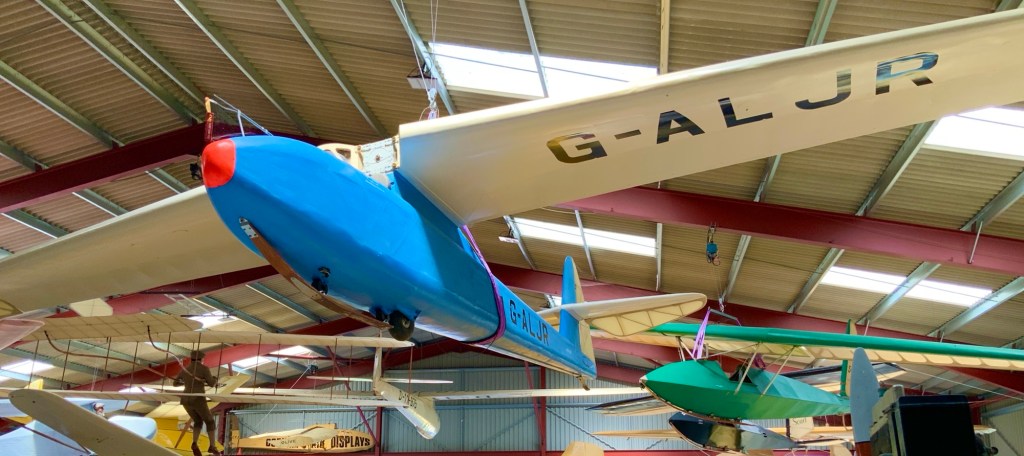
The Scud 3 was completed by Abbott Baynes, Wrecclesham, in 1936. It’s the third oldest glider in the GHC hangars that definitely flew. The second is the Scud 2 (1935) and the oldest the Willow Wren (1932).
A significant number of the gliders on display are airworthy and a small number of gliders are selected to be flown each year. With a current collection of approximately 50, each year a different selection will be chosen to be flown for the next 12 months.
Though gliders have been flying for a long time, the recent history of modern gliders is interesting. We understand that at the end of WW1, Germany was forbidden to fly engine powered aircraft under the terms of the World War I armistice. However, Germany continued to train pilots clandestinely under cover of the Deutscher Luftsportverband, a flying enthusiasts club.
Germany made freely available the technical design of their gliders for other countries to copy the structure. This seems odd and there must have been an ulterior motive.

The EoN (Elliotts of Newbury) Eton was first flown at Maidstone Grammar School (CCF unit) in 1951. EoN Etons are in fact very rare and the Lasham Glider Heritage model is believed to be the only one left that’s currently flying. It is similar to the Slingsby Grasshopper primary example in that it is extremely skeletal and intended for very short flights. As you see, it has RAF roundels on the wings
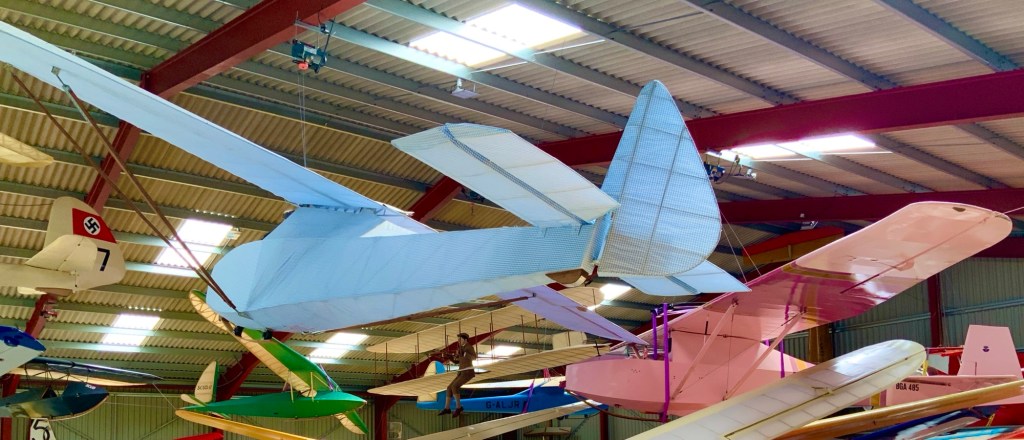
This glider is a replica of the one which was built by British Prisoners of War interned in Colditz Castle during World War II. I did research the blue material used as a skin to cover the structure. It was blue and white cotton gingham, the material used for prisoner of war duvet covers.
A member of the LHC recalled that “There was a Channel 4 documentary back in 2010 where a Colditz Cock replica was built in the same Coldiz Castle attics that the prisoners had used back in 1944/45. They experienced a number of problems and what very few people know is they had a second replica back constructed here at home base in southern England and that’s what was used to give the advice for the one at Colditz. It’s the second glider which is on display in the hanger at Lasham. The Colditz one created for the television programme was in fact launched from the roof of Colditz castle (no pilot, it was radio controlled), and did land, albeit crashed, in the same field on the other side of the river Mulde that the prisoners had intended to use back in 1945.”
https://en.wikipedia.org/wiki/Colditz_Cock


Bill Manuel’s Willow Wren. This first flew in 1932 at the London GC, Dunstable. As gliding evolved in the early 1930s, in the UK, Dunstable was by far the most important club, and the Willow Wren along with the Crested Wren played a significant part in that evolution.
This is one of the six The Willow Wren gliders manufactured by W. L. Manuel in the early 1930’s. W.L. Manuel also produced the Crested Wren – see the first photo in this post. The Crested Wren image is included in the Wikipedia page https://en.wikipedia.org/wiki/Manuel_Wren Information about definition of ‘Sailplane’ can be found on this Wikipedia page https://en.wikipedia.org/wiki/Glider_(sailplane).
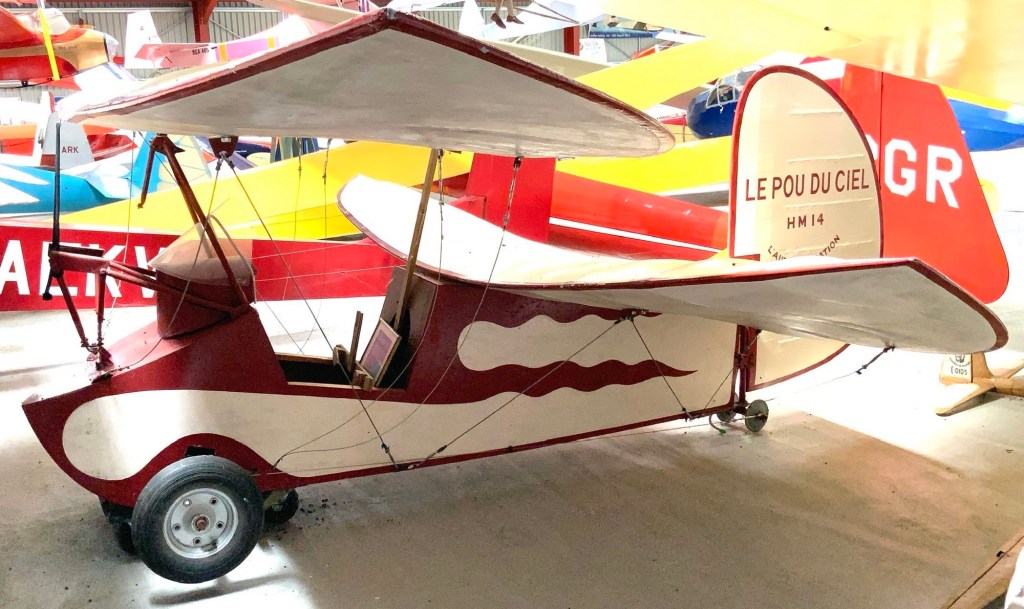
Named the Flea of the Sky, this little French near micro construction was initially claimed to be ‘idiot proof’ when first sold. Several fatal crashes later the design was modified to live up to the marketing claims. Note the compact double wings.
The “Flying Flea” to give it its British title is a replica, which members of the LHC believe was built in 1972. Note the key thing about the Flying Fleas was they had no ailerons, lateral control as such was by wing warping.
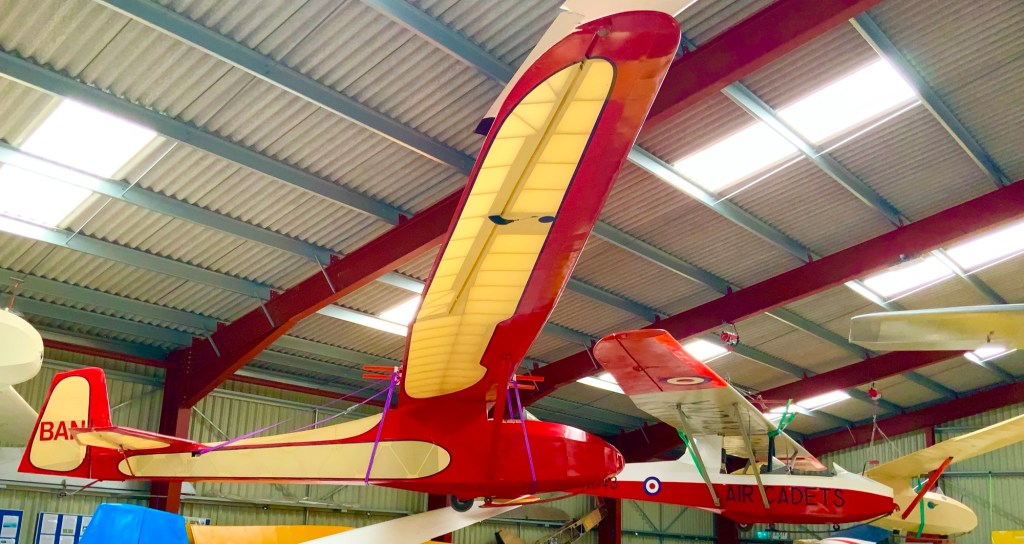
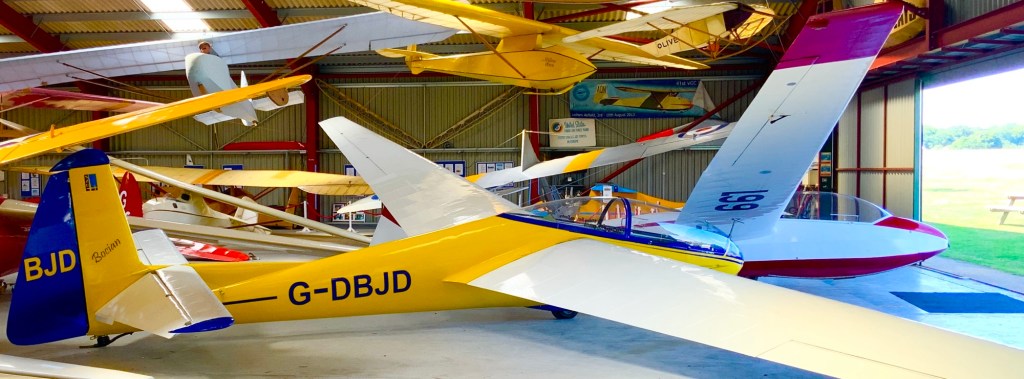
Bocian glider designed and manufactured by SZD in 1960
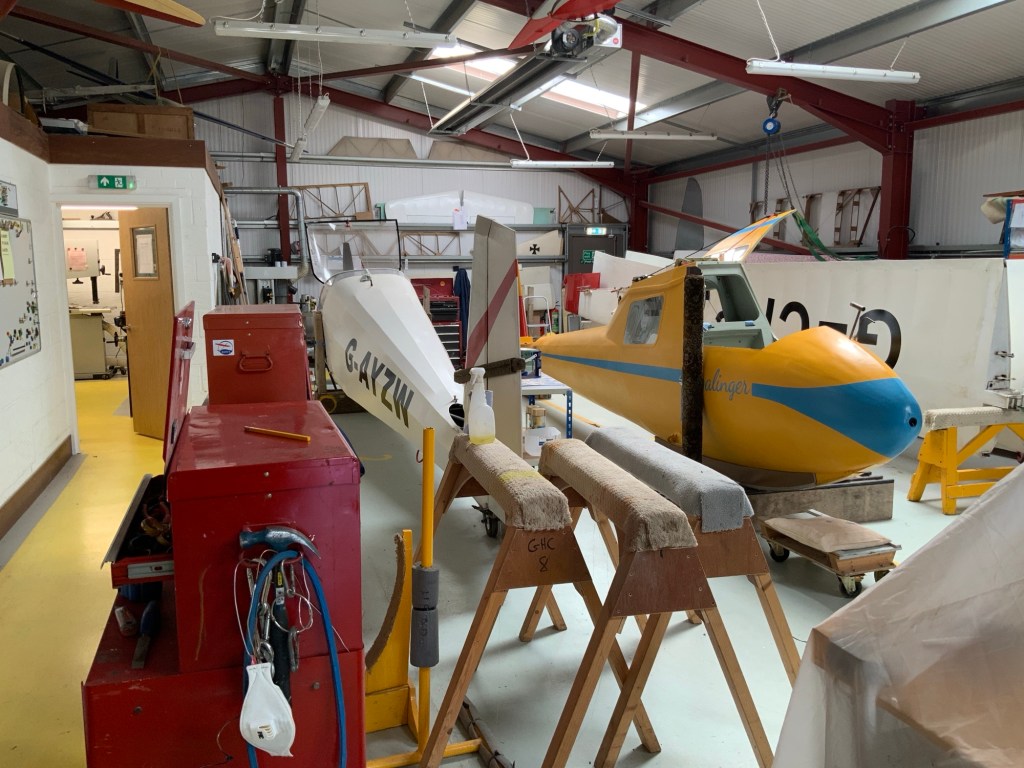
All of the collection of 50 Gliders were hand built and from time to time need a little TLC. Additionally, the Glider Heritage Centre is offered gliders from owners who no longer choose to fly their beloved gliding machines or those who inherit these often gorgeous flying machines that are not ready to permanently land. In the workshop experienced tradesmen carry out repairs and fixes to enable these gliders to continue to safely be lifted to the heights. All these aircraft are inspected by qualified experts before taking to the skies.
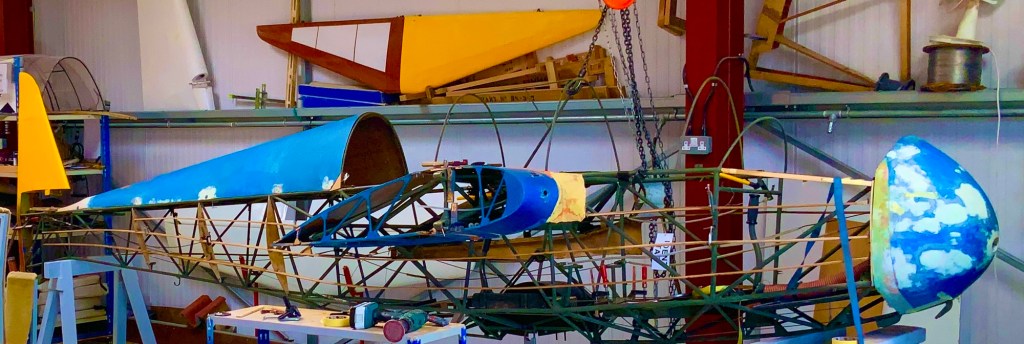
A US Laister Kaufmann TG4 built in 1942. This metal framed glider was donated to the club. There was significant rust damage and the decision was taken to restore the glider for display purposes only.
There is a comprehensive list of the gliders at the Lasham Heritage Centre, their name, manufacturer and date of manufacture and airworthiness. https://www.glidingheritage.org.uk/copy-of-collection-1
The Sunday 2.00 Tour is free and organised and run by the volunteers of the Lasham Gliding Heritage Centre which can be found at The Lasham Airfield, The Avenue, Alton, Hampshire, GU34 5SS. It would be advisable to email office@lasham.org.uk or telephone the Lasham Gliding Club 01256 384900 check that the weekly tour is scheduled to go ahead as it is run by volunteers. Donations after the tour are welcome.
Pre-arranged tours during the week or weekends can be organised by e-mailing visits@glidingheritage.org.uk .
Pre-arranged tours are popular with motoring clubs, groups of flying enthusiasts, scout groups and U3A groups, to name a few.
Should you be wondering, a Crested Wren is, in fact, another name for a Gold Crest and a Willow Wren is another name for a Willow Warbler.
Finally, our friend Tim Barnes created, crafted and painted an amazing pair of wrought iron Rock and Roll themed gates for his driveway. We are sure that the pearly gates he passed in 2023 are equally splendid.

 Claudia Bow