
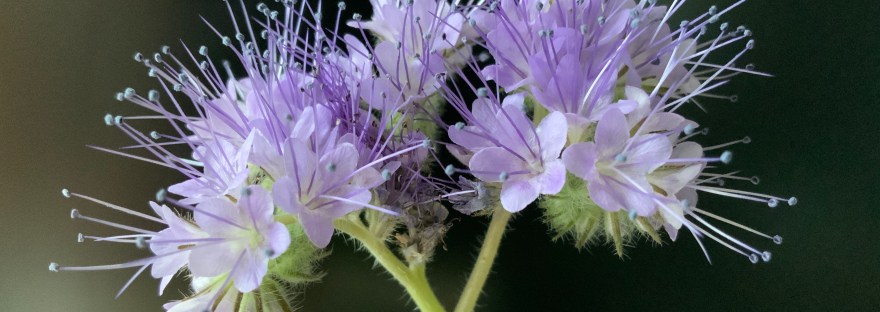
A native of South West USA and Northern Mexico, the Latin name is Phacelia Tanacetifolia. Its name is a bit of a mouthful but grown on Hampshire (UK) farms in 2023, these curious blooms were not intended for food but were part of a pretty, insect friendly, mixed seed cover crop. A cover crop is an annual crop planted by farmers to help to add Nitrogen to the soil and in turn fertilise crops. The flowers of these cover crop plants also attract pollinating insects including but not limited to Bees.

As part of a regenerative farming system, harvested land is often planted with a cover crop to help further reduce carbon emissions and nutrient loss, improve soil health and reduce the risk of soil erosion by wind and rain.
Cover crops are usually legumes such as alfalfa and clover, or cereals and grasses such as rye, barley, and also brassicas. In this instance the farmers also grew white radish alongside the Scorpion Weed and Sunflowers. The radish roots decompose and rapidly release nitrogen. This means that the next crop can get an early boost from the nitrogen captured by the radish and other green manure plants. The practice of ploughing in the cover crop also helps improve the soil structure, adding humus.
In the video you can see how a Scorpion Weed unpacks its flowers in sequence over a long period – many days depending on the weather.
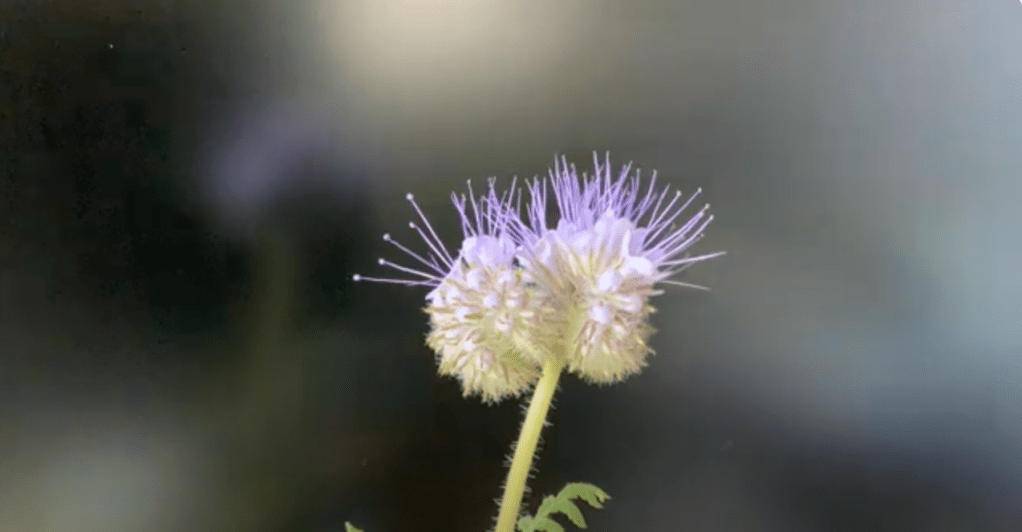
https://www.youtube.com/watch?v=xzKr7j9CSus
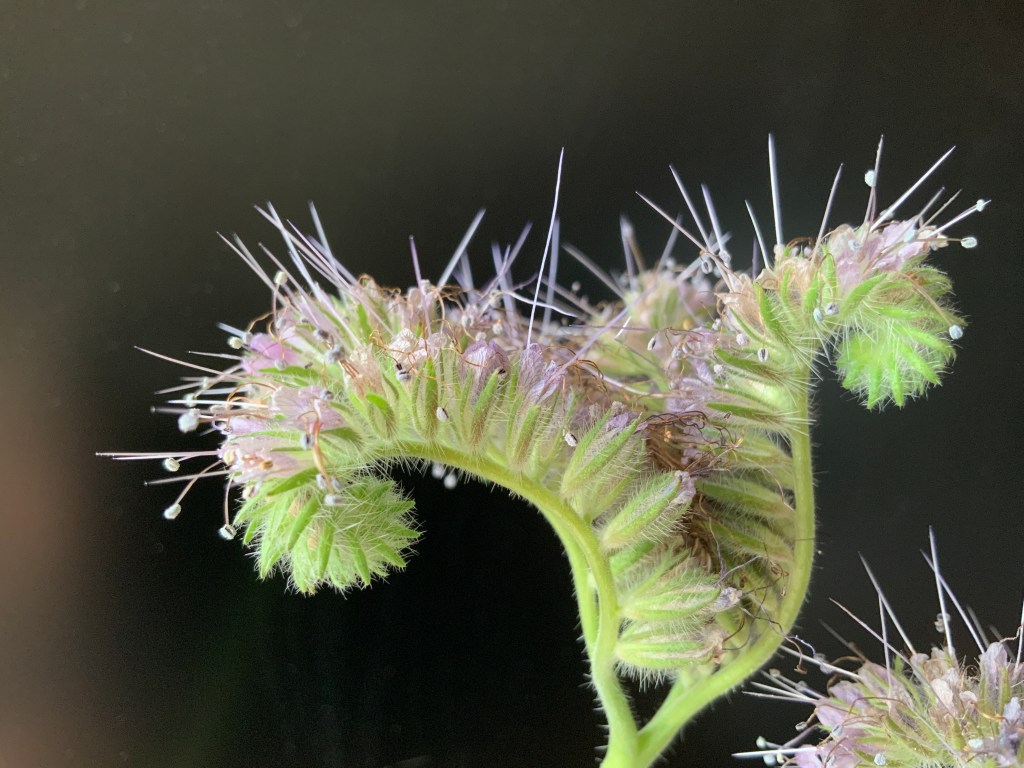
The Scorpion Weed has a number of common names including Lacy Scorpion Weed, Tansy Leaved Phacelia, Wild Heliotrope, Fiddleneck, Lacy Phacelia and California Bluebell. You can see from the flower seed head how it looks like the top of a violin or fiddle.
Now a huge internet curiosity Rabbit hole opened and in went an information hungry Mouse.
According to Wikipedia and other sources, the Scorpion Weed is a member of the Boraginaceae family. They also inform that “Boraginaceae, the borage or forget-me-not family, includes about 2,000 species of shrubs, trees, and herbs”. Who knew that Shrubs, Trees and herbs could all be part of one family?
It transpires that the borage inflorescences on each stem are described as ‘branched scorpioid cymes’.
In an Alice in Wonderland moment, things got “Curiouser and Curiouser”
This mouse thought it was time to find out just what Tree could possibly be in the same ‘Family’ as a Forget-me-not?
So into the Search box was keyed “What tree is a member of the Boraginaceae family?” This apparently is a unique question and such is its rarity that the ubiquitous Mr Google could not provide a single answer on Page 1. How odd. Google has an answer for everything! Another myth busted or could Wikipedia be incorrect or is it simply a matter of good grammar?
And talking of curiosity, did you ever wonder why the cute Forget-Me-Not acquired the botanical name Myosotis?
According to Wikipedia via a reference to Hugh Chisholm ((1866-1924) a British journalist who was the editor of the 10th, 11th and 12th editions of the Encyclopædia Britannica.), the name Myosotis comes from the Ancient Greek for “mouse’s ear”, which the foliage was thought to resemble.
If Scorpion Weeds stung, which they do not, you may need a little Hedge Woundwort. This dull weed with insignificant flowers is an absolute favourite with a variety of bees. It can only be assumed that the flowers contain lashings of nectar to entice the insects back again and again for more.

Hedge Woundwort
Historically it has been used for healing cuts and wounds, but not scorpion stings even though we do have scorpions in the UK and they do sting!
With a raft of common names such as Archangel, Red Archangel, Wild Nettle Grass, and Wood Betony, the Latin name for this inconspicuous but gutsy plant is Stachys sylvatica. It has been claimed to have magical properties.
Latin names for plants are both important and interesting. Humans have been using, collecting and sharing plants for thousands of years. The ancients, including the Greeks and Romans made significant contributions to the naming process which eventually led to The International Code of Nomenclature for algae, fungi, and plants (ICN or ICNafp). Science has played an important role in understanding and classifying all plants. These classifications ensure that all plants are clearly identifiable wherever they grow on the planet.
When you get the hang of it, Botanical Latin names make plants so much more interesting and, like any knowledge, the more you know, the more interesting and easy it is to apply your knowledge to new species.
What interesting and intriguing flowers do you know? Have you looked up their botanical names? Are there other curious flowers in the same family?
…… Coming soon …… Dragons, Daisies and Dandelions

 Claudia Bow