
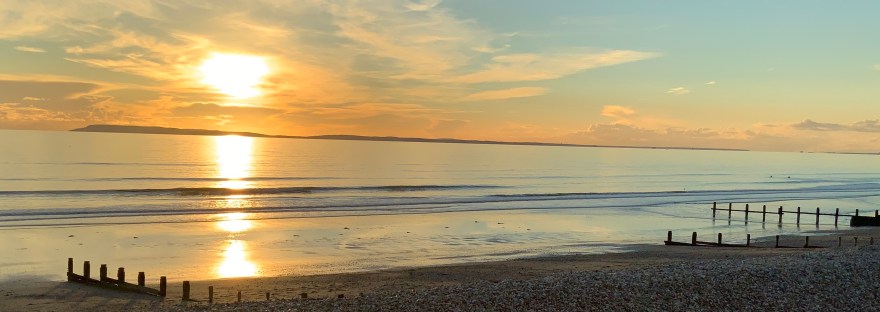
Einstein you do not need to be to work out that the best time to visit the beach is immediately after a storm.
Bracklesham Bay, east of the Witterings, can take a bashing when the full ferocity of autumnal gales crash angry waves onto the pebble reinforced sea defences of the upper beach.
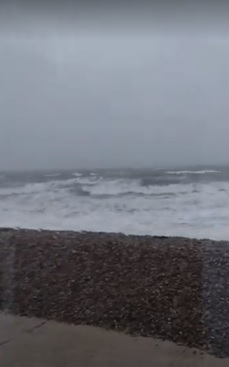
Arriving in a storm was not the intention but staying within meters of the sea definitely was. With a wall of windows overlooking the English Chanel and just a concrete path between us and the wild water only a gale force storm could make it perfect.
30 October 2021 was chosen because there was no moon and no light pollution between the beach and France save the light houses and ships.
What is more, just three days before arrival, we didn’t even know that Bracklesham Bay was famous for fossils. Well obviously not that famous.
What is even more, by pure serendipity we stayed in a ground floor flat immediately in front of the middle of the perfect fossil hunting strip of the coast between West Wittering and Selsey Bill.
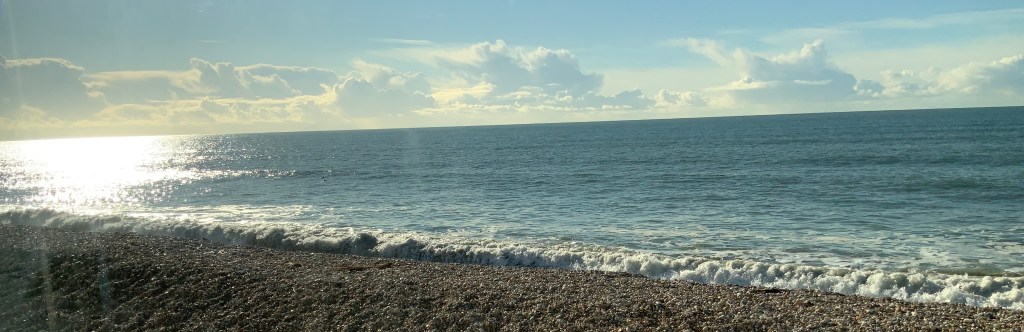
We chose that date because two full moons earlier, without pre checking an astrological calendar, we had arrived in the middle of nowhere in deepest darkest Dorset – between Sherborne and Yeovil to be exact – hoping for a magical star watching experience only to find our dark sky event obliterated by a full on Harvest Moon
So, let’s set the scene, we take washing up bowl (to hold water to pan for fossils), large holed metal sieve, fine mesh small sieve and a trowel onto the beach at mid tide. Things don’t go well. Not a fossil in sight. One of us is very bored and the other very, very, very grumpy. We quit for the day.
The next day – significantly! – the tide is further out. One of us stays home. The other goes out with:-
- washing up bowl (to hold water to pan for fossils)
- large holed metal sieve
- fine mesh small sieve
- and a trowel
Stopping to appreciate the view – and my word, what a view – I looked down to see one of these.
Turritella’s
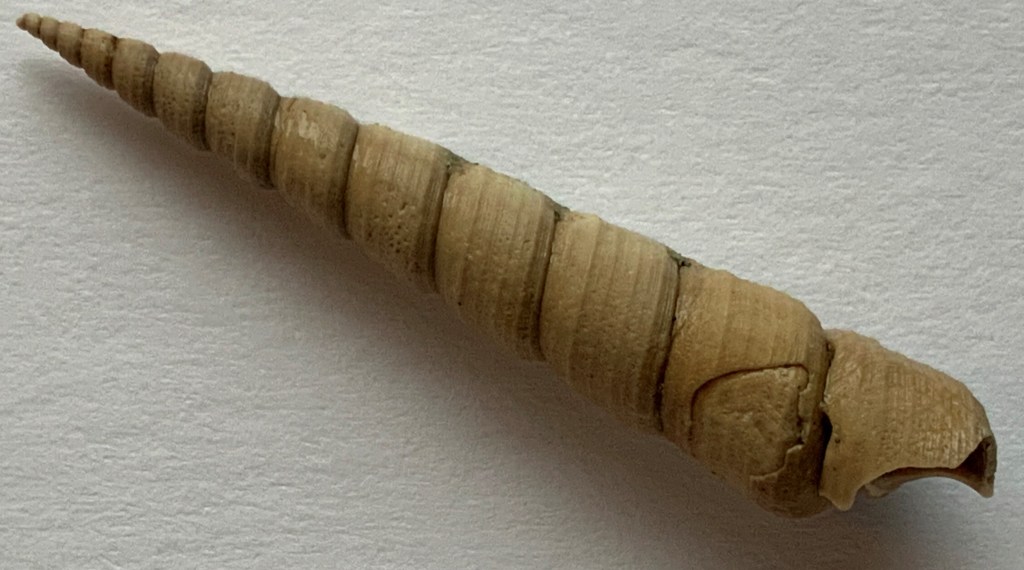
This is a fossil Turritella.
Now it might not look very exciting but this is a real fossil. It has been washed up from an area of land formed in the Eocene Lutetian era around 46 Million Years Ago (mya). This is the fossilised shell of a sea snail. These fossils can be found in various parts of planet Earth where Eocene strata is seen.
STOP. Yes, the sea snail that lived in this shell may have lived 46 MILLION years ago.
https://en.wikipedia.org/wiki/Turritell
So the fossil hunting paraphernalia was abandoned and these 46 million year old preserved shells were collected from the surface of the sand. There were literally hundreds of them swirling around in the wash of the waves.
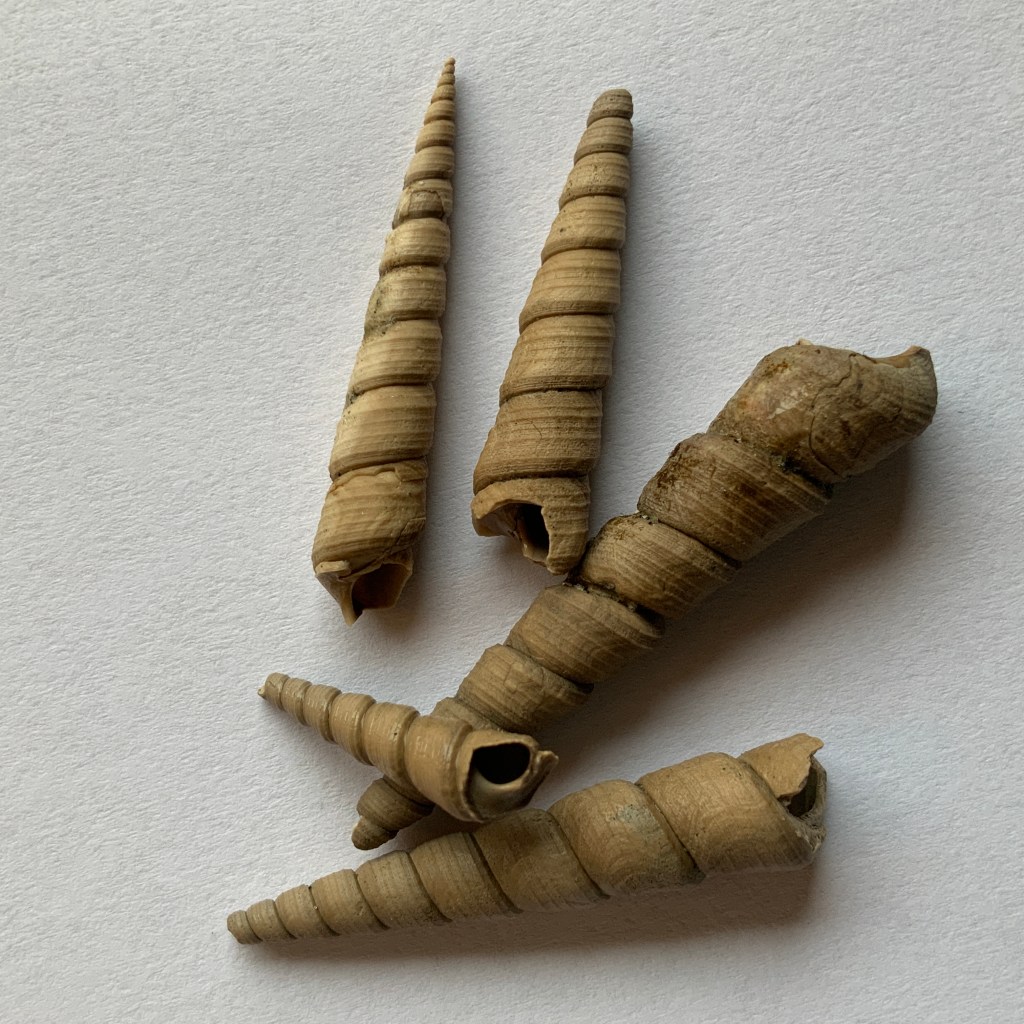
Turritella fossil ‘need to have one’ sated, a return visit to the http://www.discoveringfossils.co.uk/bracklesham-bay/ website revealed that another fossil was also readily collectable, Nummulites.
Nummulites
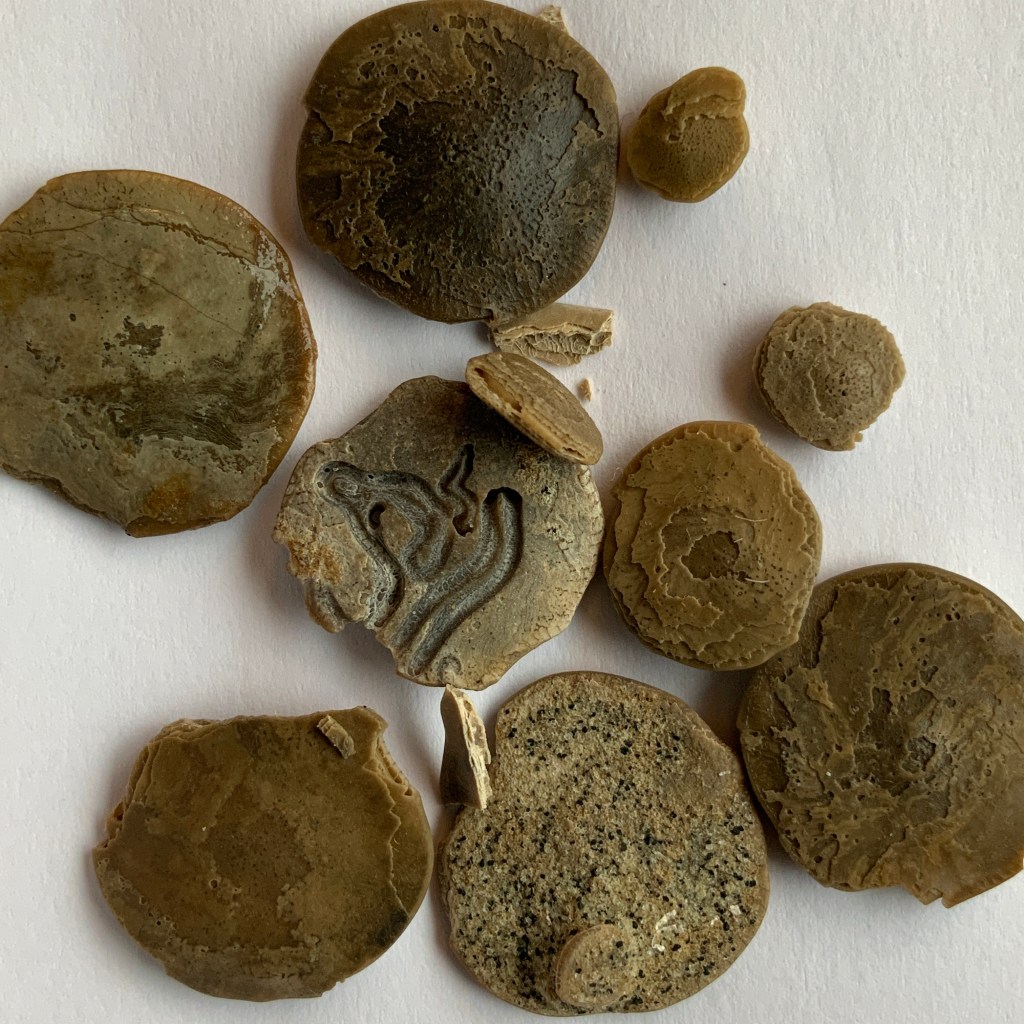
Though initially not so exciting to look at. These turned out to be far more interesting to an Algaephile.
You can find more information here. https://blogs.agu.org/georneys/2011/09/04/geology-word-of-the-week-n-is-for-nummulite/
These lenticular shaped fossils are also, nearly 50 million years old.
The ancient Egyptians found them in the sandstone used to build the pyramids. They called them Nummulites which has a Latin origin meaning coin.
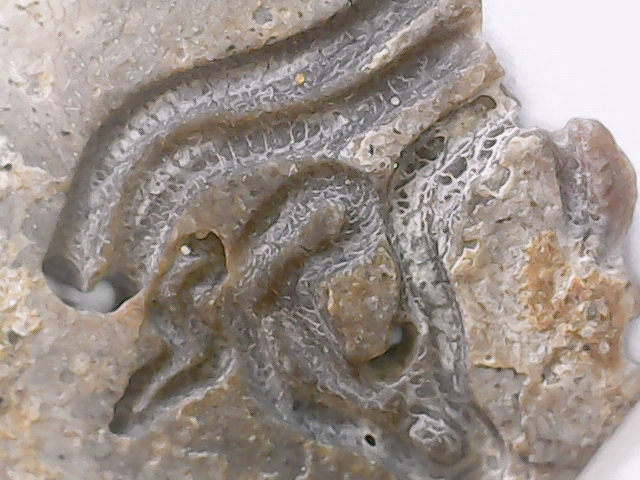
A trawl across the internet in the company of my faithful friend Mr Google revealed that unlike the Turritella fossils, the Nummulite fossils were formed by single celled life forms. These single celled life forms are referred to as Foraminifera.
According to Wikipedia Foraminifera (/fəˌræməˈnɪfərə/; Latin for “hole bearers”; informally called “forams“) are single-celled organisms. https://en.wikipedia.org/wiki/Foraminifera
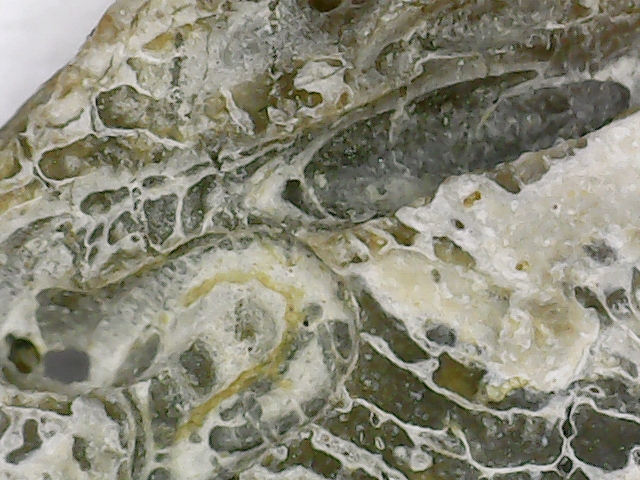
Additionally, the lengthy and detailed article notes that these shells are commonly made of calcium carbonate (CaCO3) or agglutinated sediment particles. Agglutinated apparently means to stick together and this explains the black speckles on the Nummulite in the photo below.
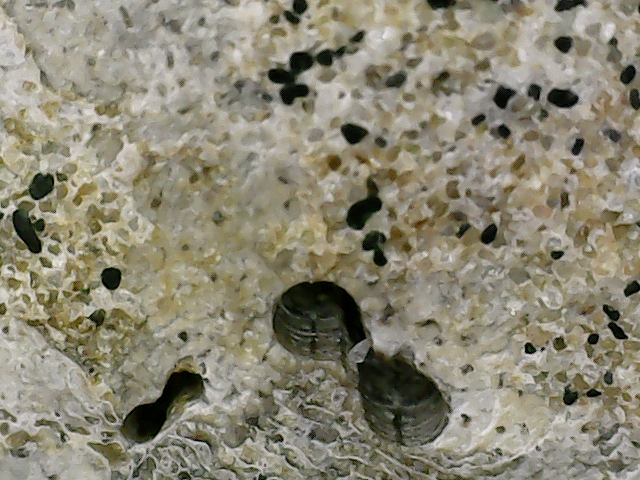
What captured my attention is the mention of a symbiotic relationship between these single celled life forms and algae. I suspect that it is the presence of algae which allowed these microscopic creatures to produce such relatively huge ‘shells’.
Venericor Bivalve
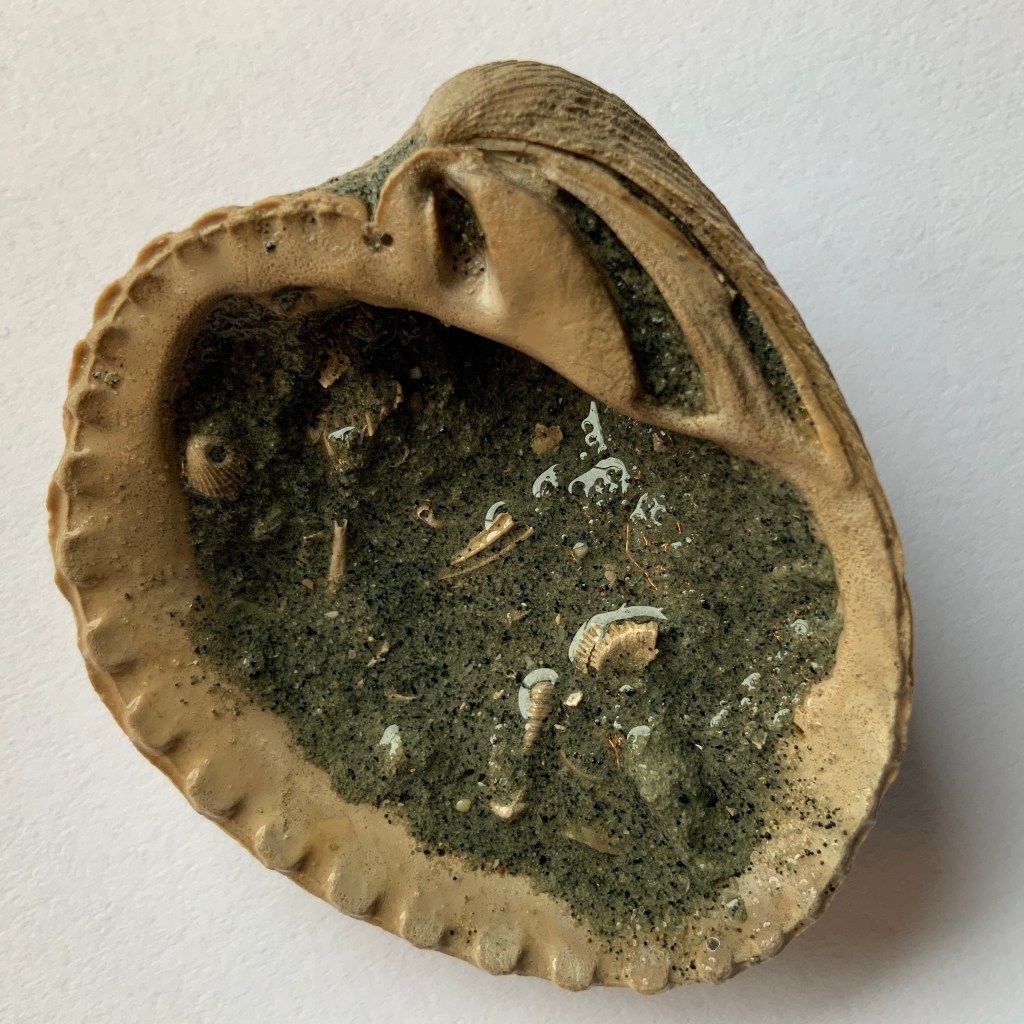
Venericor fossils are the most abundant of all fossils found on the shores along the Wittering coast line. They are relatively large – 4 – 5 cm. This is my hypothesis but please feel free to correct me. Several of the Venericor shells like the one above had what appeared to be a bluish clay with tiny fossils embedded. See the small Turritella fossil in the image above. This clay appears to be part of the blue clay in which the fossils were formed.
According to the Bracklesham Fossil Hunting website after a storm the sand can be temporarily washed away and mushroom-shaped clay pedestals belonging to the Earnley Formation can be seen.
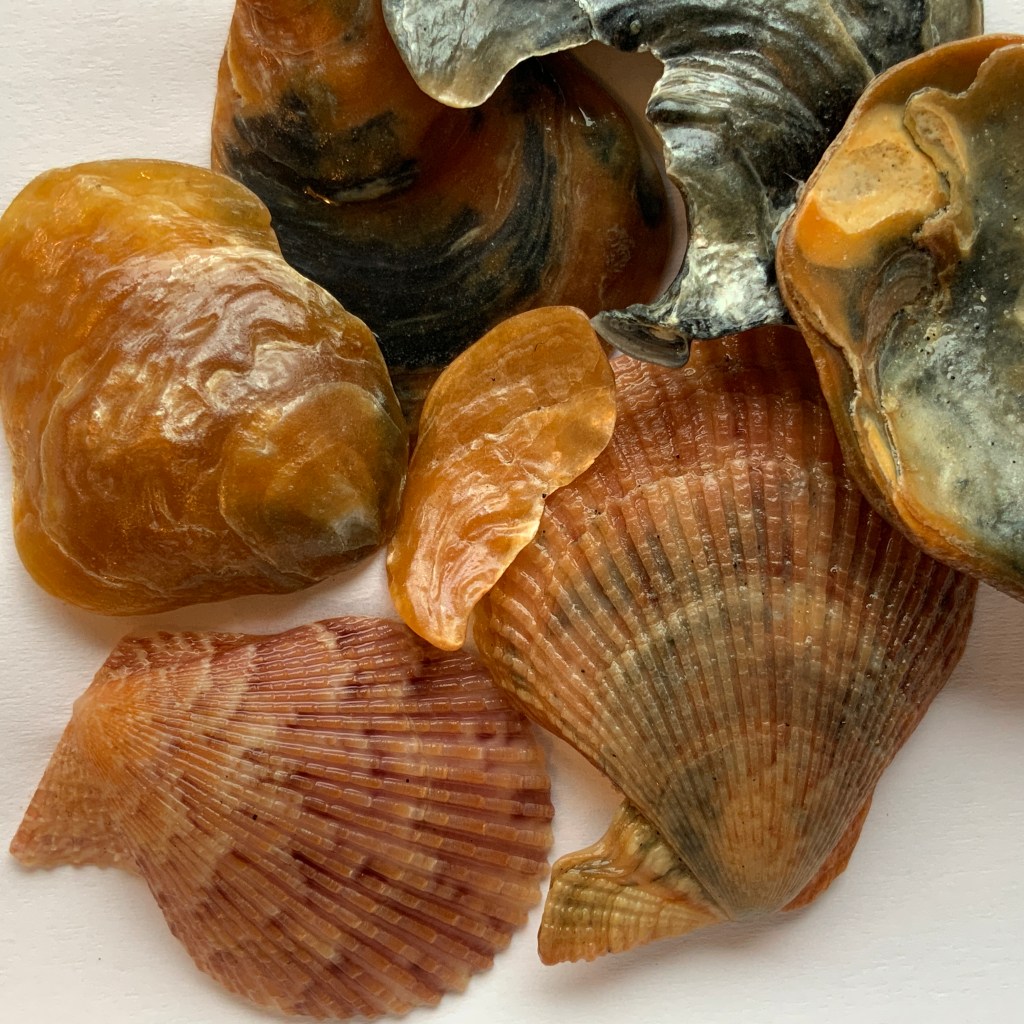
Now, as fascinating as fossils are, they are noticeably dull in colour. Here are some modern day shells you can find along this coastline.
Mr Google on an Android phone has a useful accessory. Take a photo of, well just about anything, and open the photo. You will see something like this
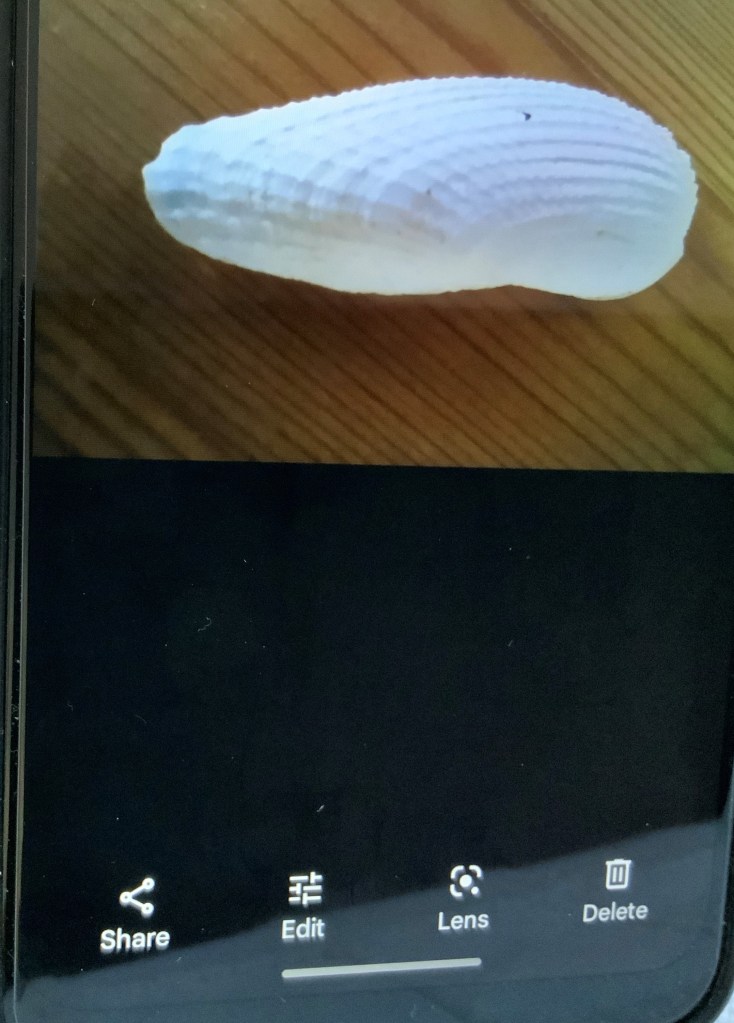
Below the image you can see the Lens Icon. Press it and this happens
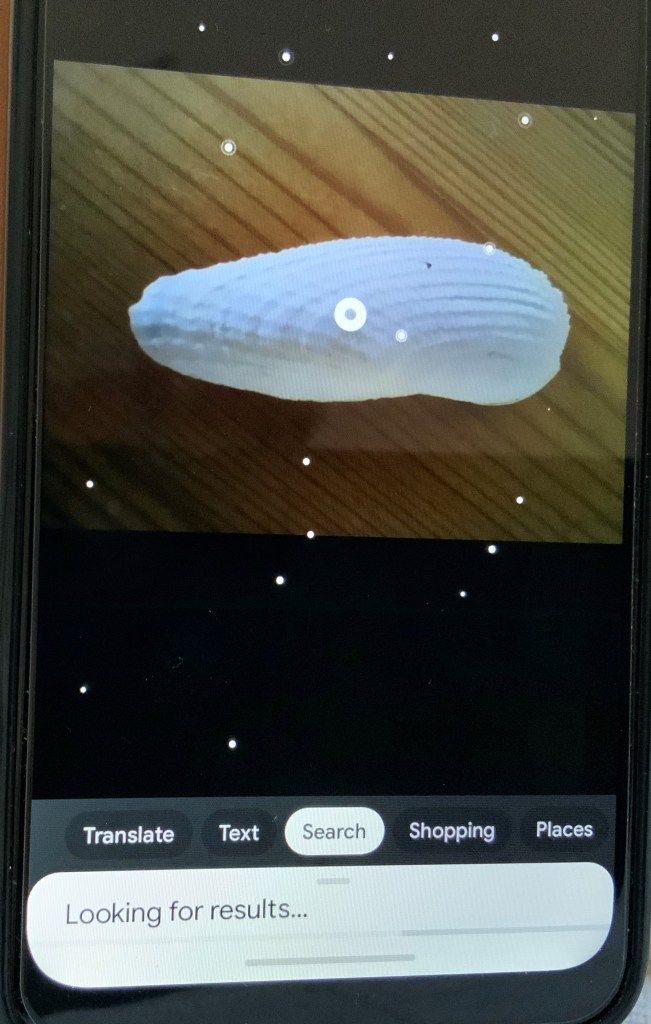
The software scans the images and AI looks through its database for similar images.
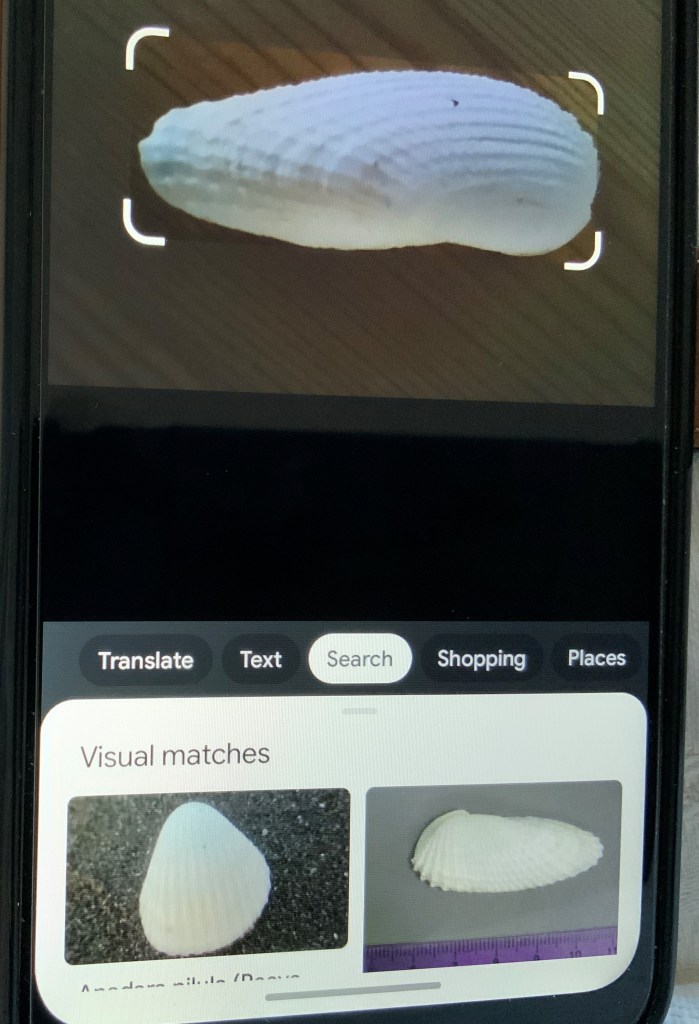
As if by magic, Mr Google finds similar images and the chances are high that you will be able to identify the object or organic thing you have just photographed.
So my favourite shell is this one
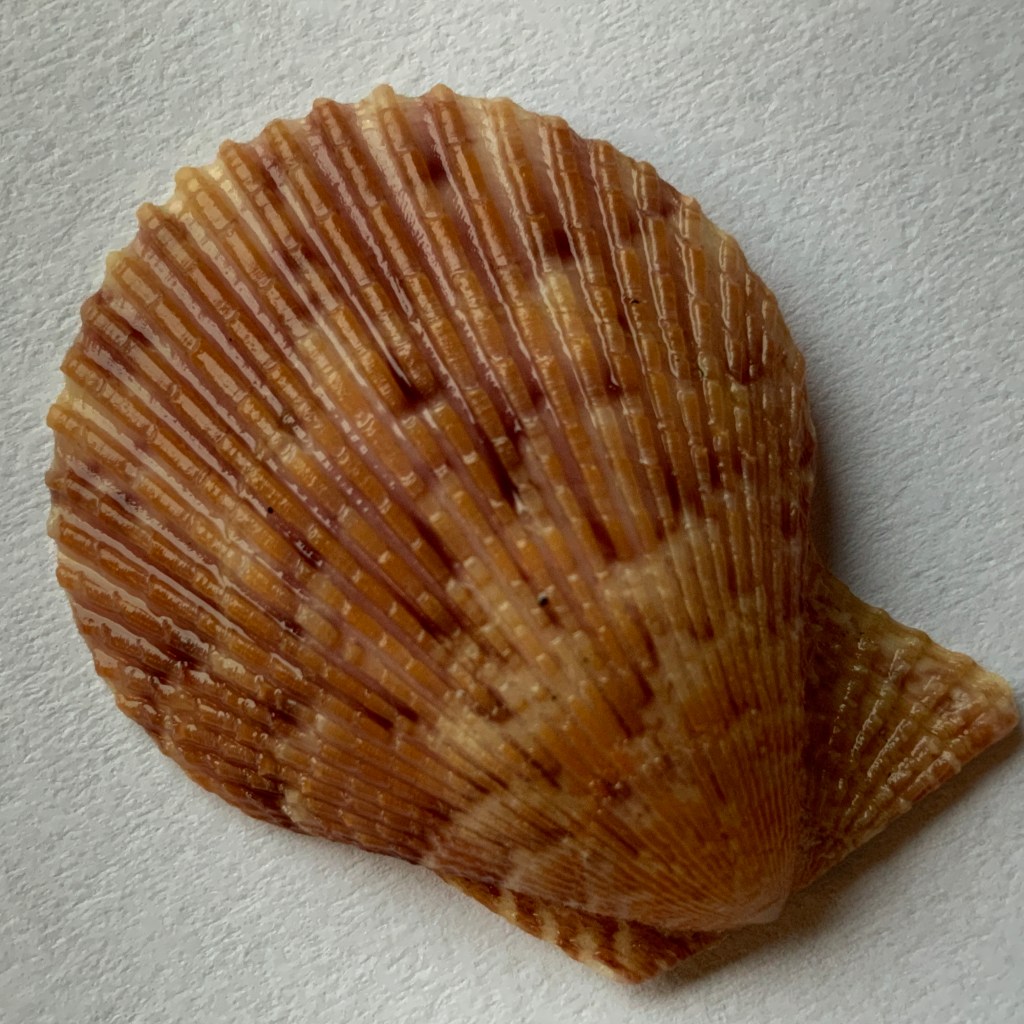
And it seems likely that it is an Argopecten or scallop. Whatever it actually is, it looks pretty.
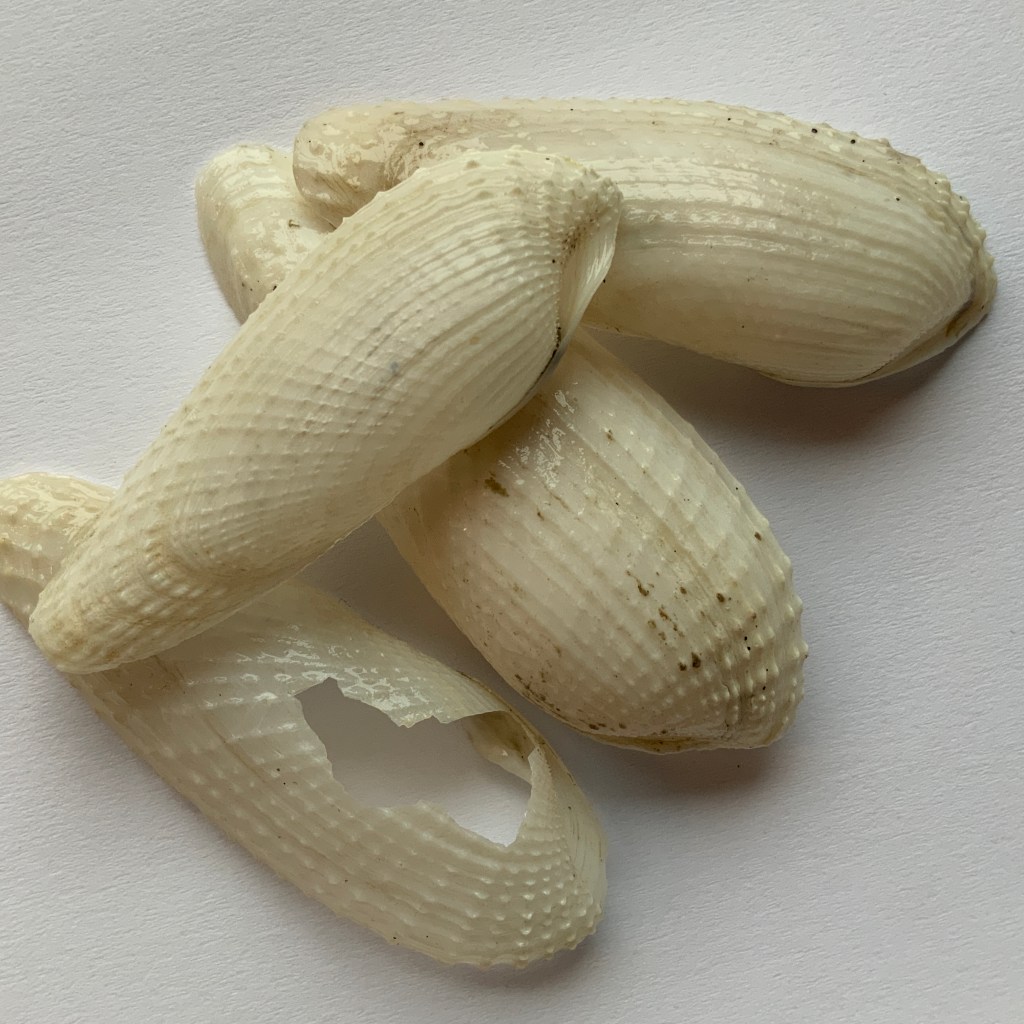
These ‘Angel Wings’ are also cute, abundant on the shoreline and often have a broken part where, presumably, a bird has pecked a hole and eaten the mollusc which was inside. They are members of the Pholadidae family and are also known as Piddocks.
According to the https://www.wildlifetrusts.org/wildlife-explorer/marine/bivalves/piddock The Common Piddock glows in the dark! Through bioluminescence, it glows blue-green around the edges.
Piddock seems a harsh name for something so delicate, white and beautiful.
And in researching this article, a mystery is resolved!
We found a soft clay object riddled with holes and tunnels on West Wittering beach. The circumference was immaculate and unlike a natural boring.
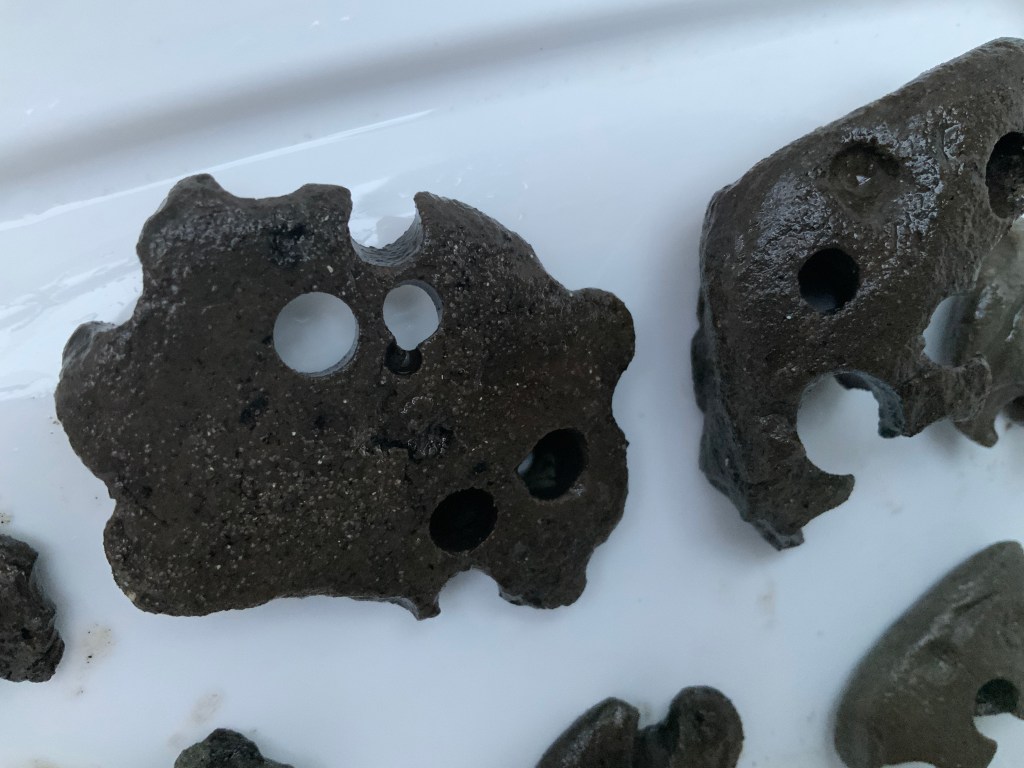
The objects looked like stones but when picked up were light and readily broke into two or more pieces.
Jo Woolf provides the answer to this curiosity https://www.thehazeltree.co.uk/2013/08/21/piddocks-anything-but-boring/ It transpires that Piddocks use their specially-adapted oval shells which are edged with fine teeth to excavate burrows in clay, driftwood and even rock.
And finally, Razor Clam shells

Bracklesham and The Witterings
So obsessed was I with fossils that I did not take any images of the Kite Surfers.
Along this beachy stretch of coastline are perfect conditions for kite surfing and these aerodynamic enthusiasts make for stunning images…… if you are not eyes down to the sand!
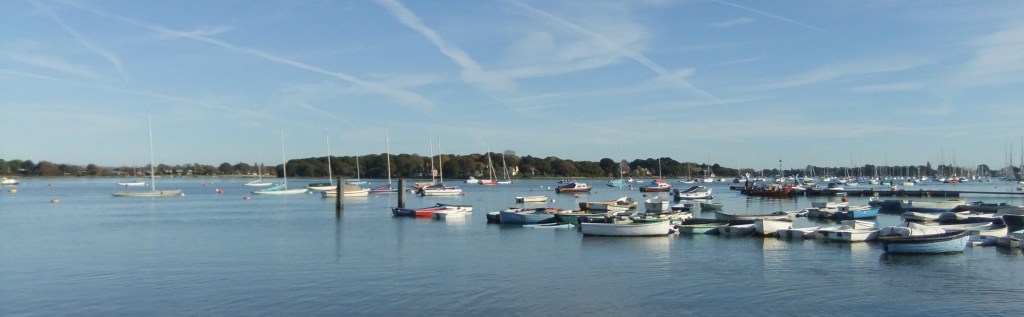
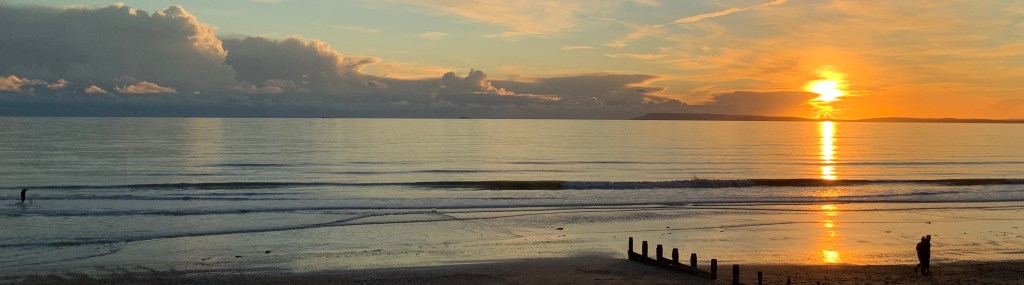
When it is calm, the water makes for excellent paddle boarding and throughout the year the hardy types regularly swim. Beware though! in rough weather and especially in storms such as we experienced, swimming is forbidden….. It can be very dangerous.
Thinking of Visiting Bracklesham to Hunt for Fossils?
These are some websites which may help to make your visit successful
Knowing when the tide will be out is essential if you are tight on time. We used this site:- tideschart.com
If you are a surfer you probably already know this site: magicseaweed.com
If you would like to know what ships are visible from Bracklesham Bay visit:- marinetraffic.com
And if you would like a fabulous plate of fish and chips visit
Billy’s On The Beach Café Restaurant Wittering, Bracklesham …https://www.billysonthebeach.co.uk
The prices are a touch pricey but the freshly caught fish is perfectly cooked.
And the Stars
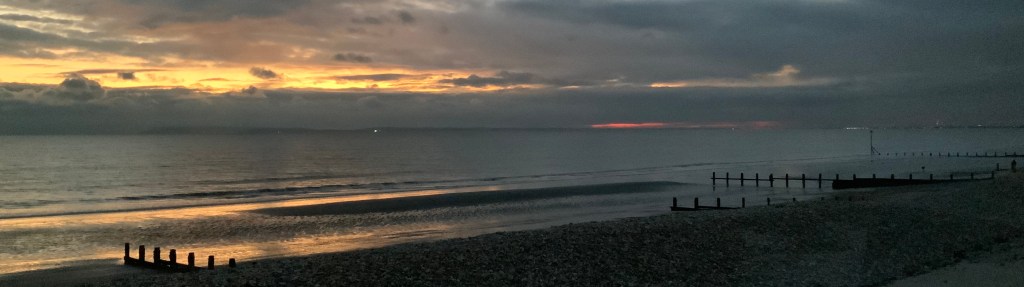
When the storm passed and the skies cleared looking to the east the stars were brilliant against a black sky at 4.00 a.m. Not quite a dark sky experience but pretty cool in any event.
All the information in this post is reasonably accurate as at November 2021. We take no responsibility for any links as they are included for information purposes only.

 Claudia Bow